Written By
The HQ Team
30 October 2025
8
Min. Read Time
Save This Article

Category
Read Time
Minutes
There is a difference between deciding that your project isn't financially ready and deciding that the economy feels uncertain. The first is a reason to wait. The second may simply be a reason to plan more carefully.
For a significant home project, that distinction matters. You're not making a $20 decision at the checkout counter. You're committing to a project that can take years to plan and months or years to complete, with decisions about design, construction, professionals, materials and financing all happening along the way.
So when the economy feels unsettled, should you wait?
Maybe.
But not necessarily for the reason you think.
The Economy Is Only One Part of the Equation
When people talk about “the economy,” they're usually talking about several different things at once: interest rates, inflation, construction costs, housing prices, employment, material costs and general uncertainty about what comes next. All of those can affect a home project, but none of them tells you whether your project is ready to move forward.
A homeowner with a well-developed design, a realistic understanding of the project cost, the right professional team and enough financial room for the unexpected may be in a very different position from someone who is still trying to determine what the project might cost.
The question isn't simply whether the economy is good or bad. It's whether your project is prepared for the conditions you're building in.
What Are You Actually Waiting For?
This is the question I'd ask before putting a project on hold.
If you're waiting for construction costs to return to what they were five years ago, how will you know when they've reached the right point?
If you're waiting for interest rates to fall, what happens if they don't fall as quickly as expected?
If you're waiting for material prices to come down, are there particular materials you're actually concerned about or is the uncertainty more general?
And if you're waiting because the overall economic outlook makes you uncomfortable, would another six or twelve months genuinely change your financial position?
There isn't a universal answer, but there is value in identifying what you're actually waiting for rather than allowing a vague sense of uncertainty to make the decision for you.
What 500 Homeowners Told Us
We asked more than 500 homeowners what they were planning for their homes and what was holding them back. The responses were revealing because the decision wasn't simply build or don't build. Homeowners were weighing cost, timing, uncertainty and whether their project still made sense in the current environment. Some were moving forward. Others were delaying. And many were using the time to plan, research and get themselves into a stronger position before committing.
We pulled the responses into The Home Project Report, which you can download and read separately if you want the full picture. The larger point is this: Waiting doesn't have to mean doing nothing.
If You Aren't Ready to Build, You Can Still Move the Project Forward
One of the biggest mistakes I see is treating planning as something that happens immediately before construction. For a major home project, the planning period can be one of the most valuable parts of the entire process. You can develop the design, understand your site, establish your scope, research and interview professionals, get a better understanding of construction costs, work through your priorities, consider different approaches to the project, and make the decisions that are going to influence everything that follows.
That work doesn't become wasted simply because you don't break ground immediately. In fact, it may put you in a considerably stronger position when you do. There is a big difference between delaying a project and preparing for one.
The Cost of Waiting Isn't Always Obvious
There is also a side of waiting that doesn't get discussed as often.
Costs won't necessarily move in the direction you want. Material prices fluctuate, but the long-term trend is up. Waiting doesn’t guarantee savings—it just delays your project.
The market fluctuates with availability. Delaying a project might feel like the safe choice, but once the market picks up, the rush on permits, materials, and trades will cause delays. Those who have their plans ready will be first in line. On that note, the professionals you want to work with may become less available.
Availability creates a rush. When demand surges, instead of having the time to thoughtfully plan your project, you might be forced into quick decisions just to secure a spot on someone’s schedule. A project that could have been carefully developed over the next year can instead become a rushed project because you suddenly decide you're ready to go.
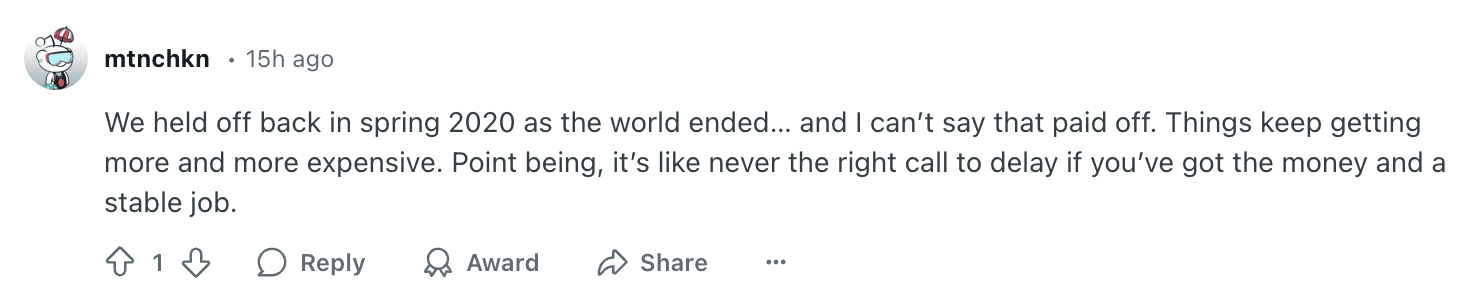
Waiting can absolutely be the right decision. But it shouldn't be treated as a guaranteed strategy for getting a cheaper project. You aren't buying a commodity with a predictable sale price. You're developing a custom home with hundreds of interconnected decisions.
Your Financial Readiness Matters More Than the Headlines
For a significant project, I'd be much more interested in your personal financial position than the latest economic headline.
Can you comfortably fund the project?
Do you understand what is included in your budget?
Have you allowed for the things you don't know yet?
Are you making decisions based on what you can realistically afford, rather than what you hope the project will cost?
Have you developed enough of the design to understand what you're actually asking someone to build?
Those questions tell you much more about whether you're ready than whether the news is reporting a recession, a rate cut or a construction slowdown. And if the answer to some of them is no, that's useful information. It doesn't necessarily mean don't build, it may mean you're not ready to build yet.
Sometimes the Best Time to Wait Is Before You Need To
If you're uncertain about the timing of your project, use that uncertainty productively. This is the time to have the conversations you won't have time for once construction begins. Talk to professionals, understand the site, develop the scope, design your home, get realistic information about costs, determine what matters most to you, and identify the decisions that could have the biggest consequences if you get them wrong.
The goal isn't to predict the economy, it's to make your project less dependent on everything going perfectly. That's a much more useful kind of preparation.
So, Should You Hold Off?
If moving forward would put you in a financially precarious position, yes. Waiting may be the right decision. If you don't yet understand the scope, cost or complexity of your project, waiting long enough to get clarity is probably wise.
But if your project is well planned, your finances are sound and the only thing holding you back is uncertainty about what the economy might do next, don't assume that waiting automatically makes the project safer or less expensive. You may be better served by continuing to prepare while you watch the market. Because eventually, the economy will change again. So will construction costs. Interest rates. Material availability. Labour. Your own circumstances.
You can't control the conditions you build in. You can control how prepared you are when you decide to build.
The Takeaway
There may never be a moment when a major home project feels completely risk-free. The better goal is not to wait for perfect conditions, but to make sure your project is strong enough to move forward in the conditions that actually exist. If you're not ready, use the time to get ready. If you are ready, don't let uncertainty alone make the decision for you.
The question isn't simply, “Is now a good time to build?” It's “Am I prepared to build well?”
The HQ Team
Homeowner HQ
The Homeowner HQ team brings together the stories, questions, ideas, and insights that matter to homeowners undertaking custom homes and major renovations. Each story begins with a question, experience, or real-world project and is carefully researched by our editorial team, with insight from experienced architects, designers, contractors, engineers, and other industry professionals where relevant. Our role is to ask the questions, investigate the details, and bring together perspectives that help homeowners better understand what goes on behind the scenes of a home project.