Written By
Chelsey Morphy
21 August 2025
4
Min. Read Time
Save This Article
Category
Read Time
Minutes
When you're looking at a house with plans to change it, the question isn't always “How much will the renovation cost?” Sometimes the more important question is whether the house itself is worth renovating.
It can be tempting to look at an older home and immediately imagine what it could become or assume that starting over will be simpler. Neither is necessarily true. A renovation can uncover opportunities that aren't obvious at first glance, while a demolition and rebuild can introduce costs and constraints of its own.
The answer comes down to the existing structure, the scope of what you want to change, and the realities of the site.
Start With the Bones
Before thinking about kitchens, bathrooms, finishes or floor plans, understand what you're actually working with.
The condition of the foundation, framing, roof structure and other major components can have a significant influence on whether renovation makes sense. So can issues such as water damage, poor construction, erosion or outdated systems.
If the fundamental structure is sound, there may be considerably more value in working with what already exists. You're not starting from zero. The foundation, framing and portions of the existing structure may already be doing much of the work you would otherwise have to pay to build again.
There can also be value in what you can't easily replace: the character of an older home, established landscaping, or a property that has qualities that would be difficult to recreate.
It Doesn't Mean Keeping Everything
A renovation doesn't have to mean preserving the house exactly as you found it. Some of the most substantial renovations involve opening up the existing structure, changing the floor plan, adding to the footprint or completely reworking the interior.
The question is not whether the house is old. It's whether the existing structure gives you something worth working with. That distinction matters because a major renovation can still involve significant demolition. Walls may come down. Systems may be replaced. Floors and ceilings may be opened. Portions of the house may be rebuilt.
In other words, renovation and rebuilding aren't always as separate as they sound.
The Cost of Starting Over
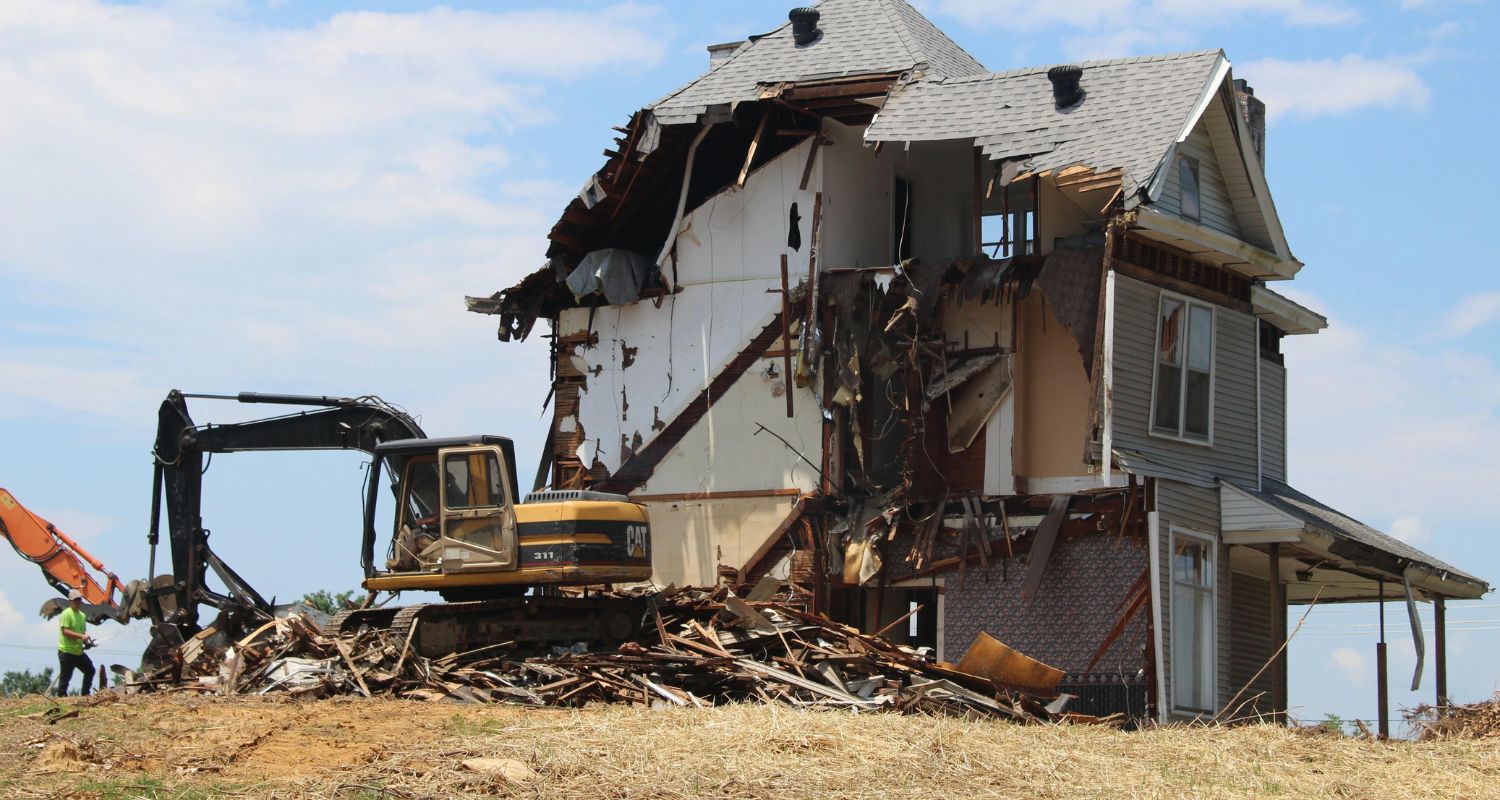
Demolition can look deceptively simple from the outside. A machine arrives. The house comes down. The site is cleared. But there is considerably more involved.
Depending on the project and local requirements, you may need permits, testing, utility disconnects and specialized removal. Then there is the cost of transporting and disposing of the material that comes out of the house.
And once the site is cleared, you're starting again. A new foundation. New framing. New roof structure. New exterior. New mechanical systems. New everything.
That doesn't automatically make demolition the wrong choice. It simply means the comparison needs to include the full cost of both paths, rather than comparing the cost of renovation work with the cost of putting up a new structure.
When Rebuilding Starts to Make More Sense
There are situations where the existing house becomes more of a limitation than an asset.
A rebuild may warrant consideration when the existing structure:
Has significant water, fire, insect or erosion damage
Has serious construction deficiencies
Requires extensive structural work
Cannot accommodate the layout you need without substantial intervention
Creates limitations that are expensive to work around
Would require so much renovation that starting again becomes more practical
A new home also gives you the opportunity to approach the property as a whole, from orientation and layout to energy performance, structure and mechanical systems, rather than adapting those decisions around something that already exists.
In some cases, that can make rebuilding the more sensible long-term choice.
The Planning Matters More Than the Label
One of the mistakes homeowners can make is deciding “renovation” or “rebuild” too early. Before committing to either, understand what each option actually involves.
What can stay?
What needs to change?
What will the structural work cost?
What will demolition and disposal cost?
What does the existing site allow?
What will each option give you when the project is finished?
And perhaps most importantly: Which option gets you closer to the home you actually want without taking on unnecessary work?
There isn't a universal answer.
In my experience, I've worked on hundreds of substantial renovations and additions, including homes more than 100 years old. I've yet to have a client or contractor tell me afterward that they should have demolished and rebuilt simply because the house was old. However, I've also witnesses neighbouring projects where the clients renovated only to find out they had to remove everything. The cost of removing piece by piece until everything is demolished could have been avoided.
Sometimes the existing structure is the greatest asset on the property. Sometimes it's the greatest limitation.
Look at the Whole Project
The decision becomes much clearer when you stop looking at the house as simply old or new and start looking at the project as a whole. A renovation may preserve valuable structure, character and existing site conditions. A rebuild may give you greater freedom to create the layout, performance and functionality you want.
Neither is inherently better. The right choice depends on what you're starting with, what you're trying to achieve and what each path will realistically require.
Before you make that decision, get the existing house properly assessed and have professionals help you understand the structural, design and financial implications of both options. Because the most expensive decision isn't necessarily choosing renovation over demolition or demolition over renovation. It's committing to one before you understand what you're actually buying into.
Chelsey Morphy
Home Consultant
Homeowner HQ
Chelsey Morphy is an architectural designer, home consultant, and the founder of Homeowner HQ. With nearly two decades of experience in new home and renovation design, she brings a rare dual perspective as both a designer and homeowner. Her mission is to bridge the gap between homeowners and industry professionals by offering education, guidance, and real-world support that simplifies the building process. Her work has been featured on HGTV and trusted by hundreds of clients, contractors, and fellow designers alike. Now she’s creating the go-to platform, Homeowner HQ, for planning, budgeting, and managing home projects with confidence.