Category
Read Time
Minutes
I was talking with a carpenter the other day, someone who has been framing multi-million dollar homes for the last 15 years, and we got onto the topic of construction tips online. The kind that look organized, efficient, and honestly… a little impressive.
If you’ve spent any time watching renovation or building content, you’ve probably seen them too. Clean layouts, labeled everything, systems that make it feel like the project is running at a higher level.
But as we started talking, one example came up that perfectly captures the gap between what looks like a good idea and what actually adds value to a project.
Stencilling and marking everything out on the floor before drywall.
The Kind of Detail That Feels Right
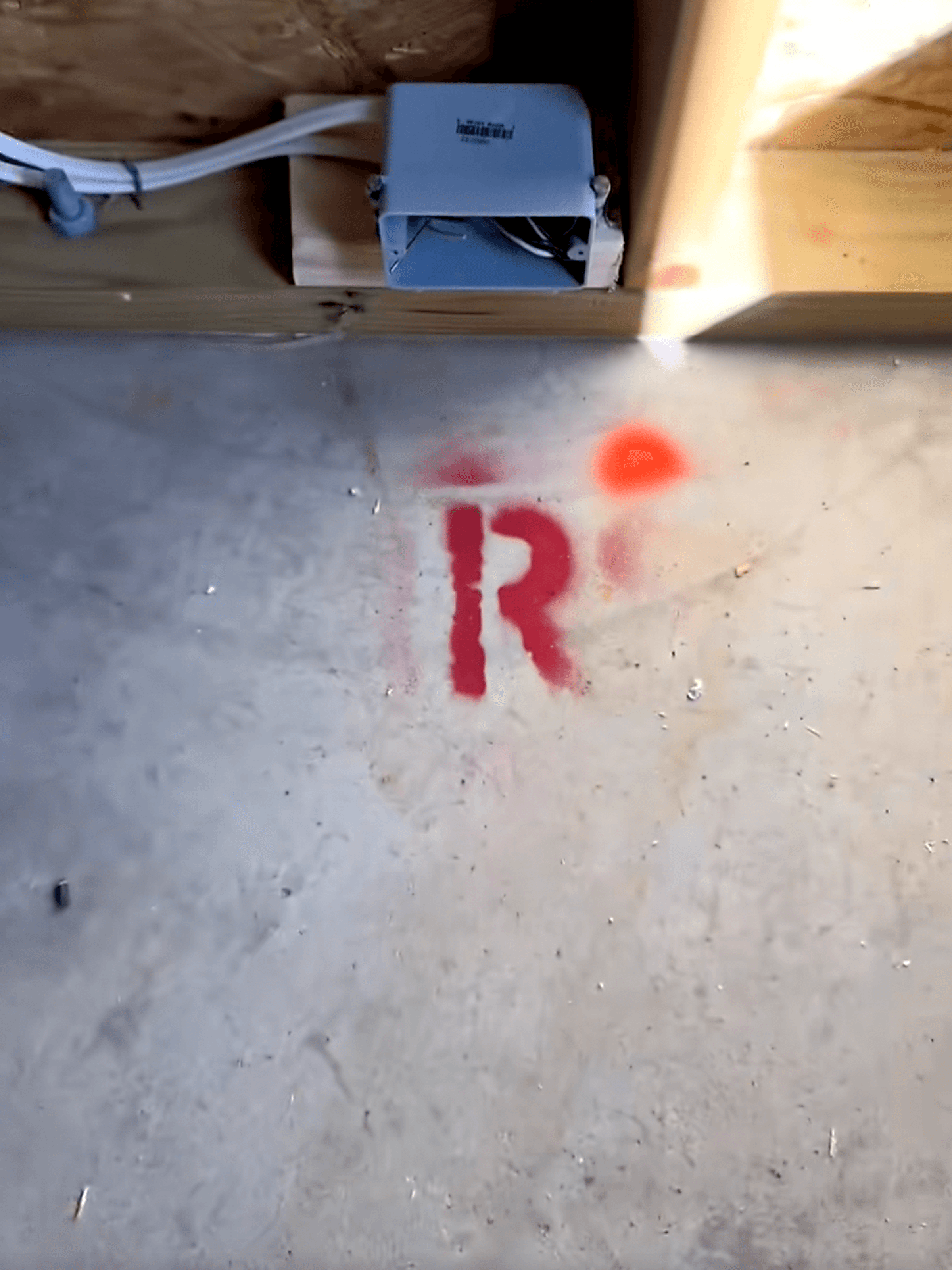
In the video I had seen (along with 25,000 others) the floor was covered in markings. Electrical boxes were carefully stencilled with their heights and locations. HVAC returns and vents were mapped out. Light switches, reciprocals, even stud locations were all clearly marked or stencilled in different colours.
At first glance, it feels like the kind of attention to detail you want on your project. It looks organized. It looks thoughtful. It gives the impression that nothing is being left to chance.
And as a homeowner, it’s easy to assume that more detail like this must mean a better end result.
What Actually Happens Next
But construction doesn’t stop at that moment.
After those markings are done, drywall goes up. Then comes mud, tape, primer and paint. Then flooring gets installed.
Everything that was carefully mapped out on the floor is completely covered.
Gone.
And not in a “we’ll reference it later” kind of way. In a “that effort no longer exists within the project” kind of way.
The Hidden Cost No One Talks About
The issue isn’t just that it disappears. The issue is what it takes to get there.
Every one of those markings takes time. It takes someone countless hours on site to measure, label, and double check. So while it might look like a small step, it quietly adds up.
More time.
More labour.
More cost.
Without actually improving how the project is built.
What Experience Actually Looks Like
The interesting part of that conversation was how simple his response was.
They’ve never stencilled a single item that was listed above.
Not once.
And they’ve never lost one either.
I can also say the same with the projects I've worked on.
Because experienced trades aren’t relying on floor markings to do their job. They don't need to know where the studs are to hang drywall. They hang a single sheet and screw into the studs in that moment. They cut the outlets in that moment.
The markings might look like precision, but in reality, they’re solving a problem that doesn’t really exist.
Why These Ideas Spread
There’s a reason these types of “tips” show up everywhere.
They’re visual. They’re satisfying to watch. They give a clear before-and-after moment that feels like progress.
And for someone who isn’t on site every day, they create a sense of control. Like everything is being tracked, labeled, and handled with care.
But building a home isn’t about how something looks in a moment. It’s about what actually contributes to the end result.
What Homeowners Should Take From This
This isn’t about calling out one specific method. It’s about understanding how easy it is to add layers to a project that don’t actually move it forward.
When you’re building or renovating, every decision has a ripple effect—on your timeline, your budget, and the overall efficiency of your build.
And some of the most convincing ideas are the ones that feel productive without actually being useful.
So before you adopt something you’ve seen online, it’s worth asking a simple question:
Is this improving the build itself, or just the appearance of the process?
Because the difference between those two is often where projects either stay on track… or slowly start to cost more than they need to.
Want to Do Something That Actually Helps?
If you’re reading this and thinking, okay… so what should I be doing instead? There is one simple step that will save you time, money, and frustration later. Read it here in our Private Headquarters.



Comments
Get more practical tips, real stories, and expert-backed advice for your project.